
In January, after four years of marriage, I told my wife I wanted to separate. I’d recorded episodes for the 📝Future Wife Podcast for seven years before we were introduced at 📝Symposium—slowly narrating the relationship into being, long before we became 📝Partners in Presence. Early on, we aligned on a 📝frame:
“If we take 📝eternity to mean not 📝infinite temporal duration, but timelessness, then the eternal life belongs to those who live in the present.”
Trying to sum up what we shared and lost—the potency of its 📝magic and the magnitude of its challenges—would be, as she said in her vows, an attempt to “📝Eff The Ineffable.” But where the ineffable nature of 📝presence and 📝love can’t be encapsulated in language, the State of California insists that the end of love is very much… effable.
Logistics Replace Love
If you’re unfamiliar with the logistics of getting married, it’s laughably simple. In 📝Los Angeles, CA specifically, all it takes is one single-page form—a marriage license application. You apply for it at the courthouse, have your ceremony within 90 days, and you return the license with your officiant’s signature. That’s it. Congratulations! You just got married. Getting 📝divorced, on the other hand, is less a ceremony and more a slow unthreading. When separating, you replace romance and hopes for a bountiful future in collaboration… with bureaucracy and the emotional arithmetic of untangling a shared life—where every memory becomes a line item and every dream dissolves into a dispute. It’s an administrative labyrinth that makes it apparent that your marriage to your spouse has always been a threesome with the government. As 📝James J. Sexton, Esq. said, “Everyone has a prenup. If you didn’t write it, the state did.” Even if you do it amicably and collaboratively, it will still be a part-time job and/or cost you a bucket of cash. That’s 📝Divorce Inc in a nutshell.
Inventory Gets Intimate
Regardless of how any couple arrives at the decision to separate, or the emotional state of both parties when the decision is reached, the process begins with one party filing a Petition for Dissolution of Marriage—in this case, me—and serving their spouse a Summons that formally notifies them that the era of “us” is ending and it’s now a matter of public record. After the petition comes the exchange of 📝Property Disclosures. This includes listing all assets (like financial accounts and personal property), debts (such as mortgages and credit card balances), sources of income, and ongoing expenses… along with supporting with accurate documents, like recent statements or appraisals. For those of us without a paperwork kink, it’s bureaucracy at a scale that makes you question why you believed in the institution of 📝marriage in the first place. I had sixty days to submit mine after filing my petition, and knowing it would be a massive chore, I put it off while finishing the new build of 📝MythOS. Unexpectedly, I received hers before I’d filed mine, and the foreshadowing was right there in her email when she said, “this may have some glaring or obvious error, I tried my best.” @[sic] When I finally sat down to review her disclosures, I started to place a pink tab next to the questionable or outright errant answers in her response to my petition—and there were many. She knew I knew her financial landscape, so I didn’t think she was hiding anything. Still, it certainly did seem like this had been completed… hastily. I can’t really say it was even a 📝Good First Draft, and I didn’t want to outright assume it was 📝Weaponized Incompetence. Nevertheless, a lot would need to be corrected and refiled to the state, which was sitting patiently in the corner cuck chair waiting for its next turn.
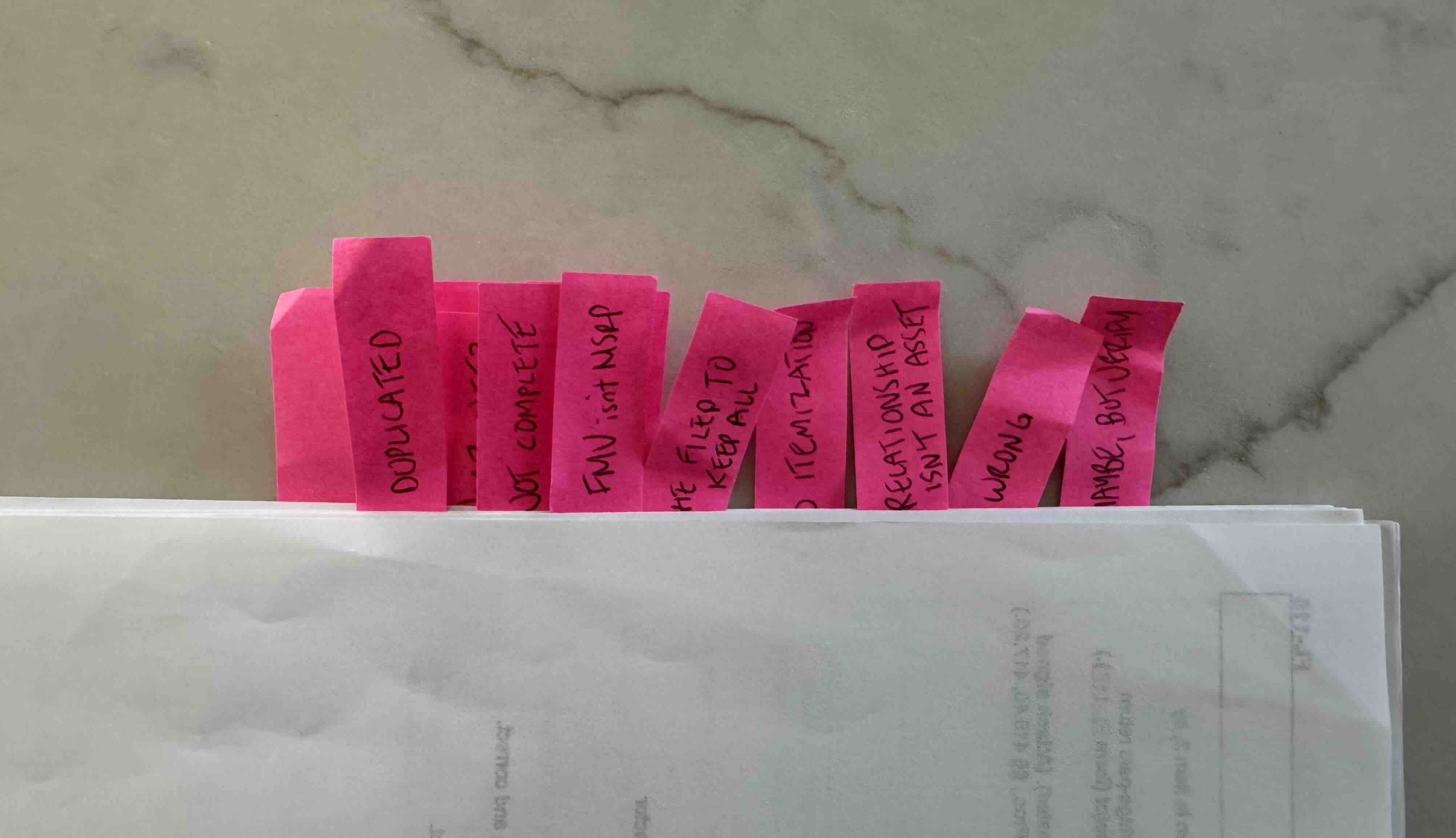
Spreadsheet Surrealism Strikes
Completing the 📝Property Disclosure means listing every single thing you own—when you bought it, what you paid, and, most importantly, its current 📝Fair Market Value (FMV): what a willing buyer would pay a willing and informed seller in the real world. You’re allowed to group together less valuable items, but my soon-to-be ex-spouse was both under-inclusive and unnecessarily over-detailed. She left out plenty, which made sense—to some degree—given she wasn’t living in the home we once shared. Yet what she did list, she listed with a poetic maximalism—writing the smallest of artifacts into rows for individual assessment. Near the top of her list: the IKEA shelf she’d bought for $50 before we met. When we moved from our apartment into 📝Our Home, she had no use for it, so it became my project—I painted each shelf a different color and filled it with creative mementos. Legally, though, it was still her property unless I wanted to buy her out (or she wanted to pay extra for my handiwork). When it came to the fair market value, she listed the shelf at exactly $50. So, zero 📝depreciation after six years. Maybe, I thought, that was a nod to the appreciation in value resulting from my artistic abilities… but then I kept reading.
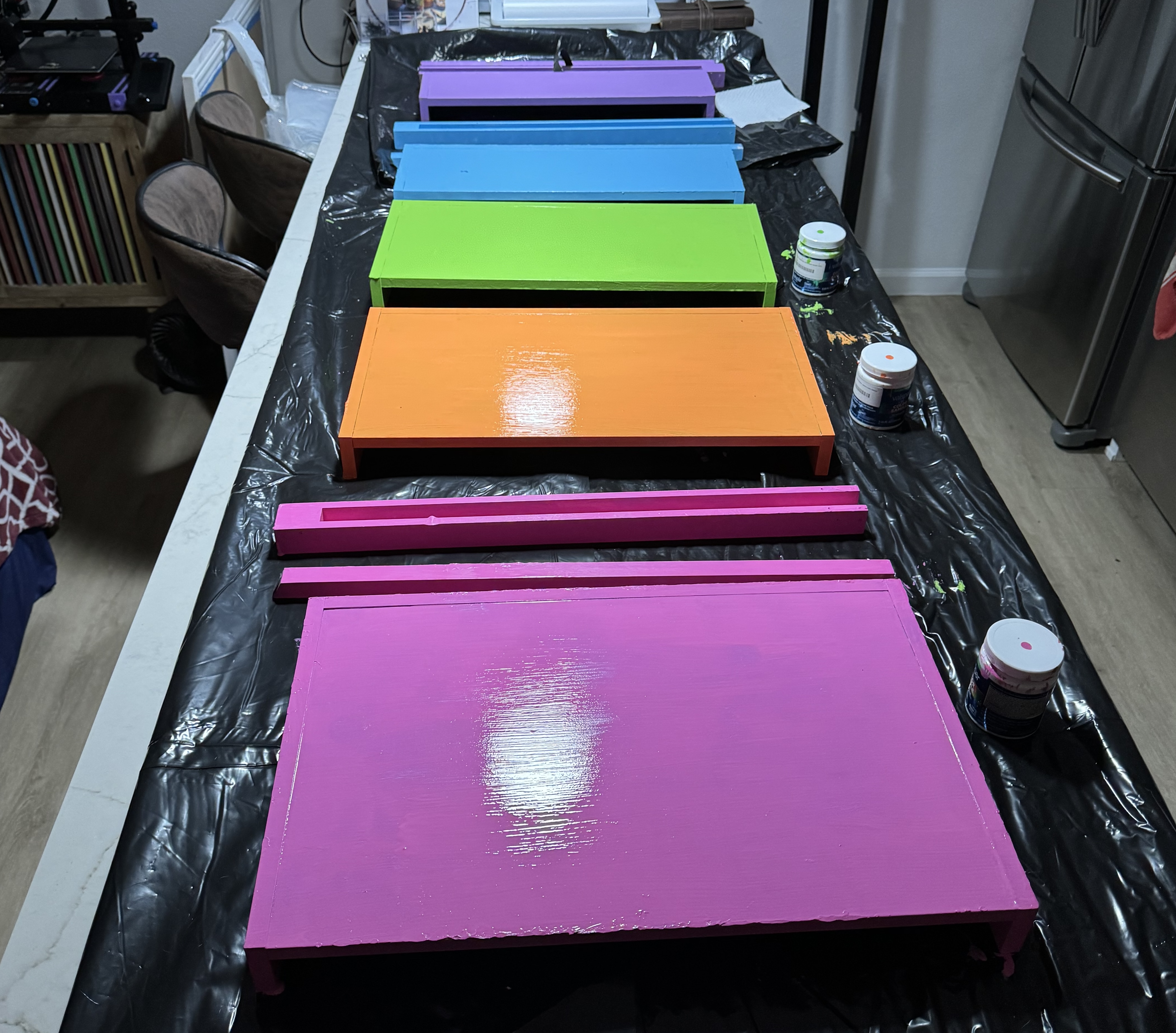
The rest of the items fit the same pattern, most with no depreciation or something resembling an attempt at 📝Straight-Line Depreciation—both seemingly devoid of any market research or an understanding of how a fair market value is defined. Towards the middle of the last page—well, the second page—it same thing either way—there it was…
- Category: Special Interests
- Item: Dildo My memory flashed back to the day I’d taken her to 📝Pleasure Chest to celebrate her return from a 21-day professional training—the longest we’d been apart at that time—and to make sure she didn’t miss me so much next time she was gone.
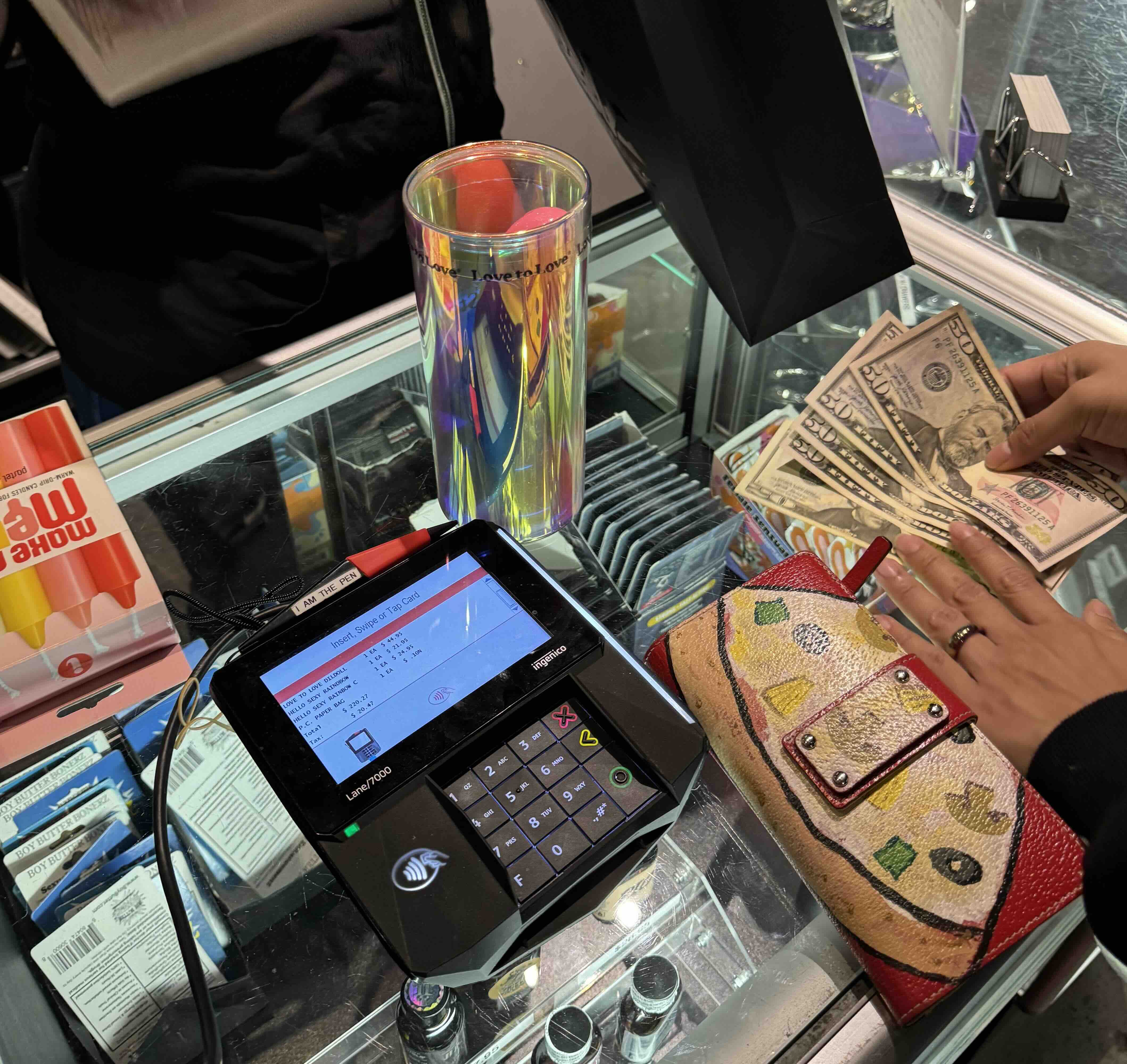
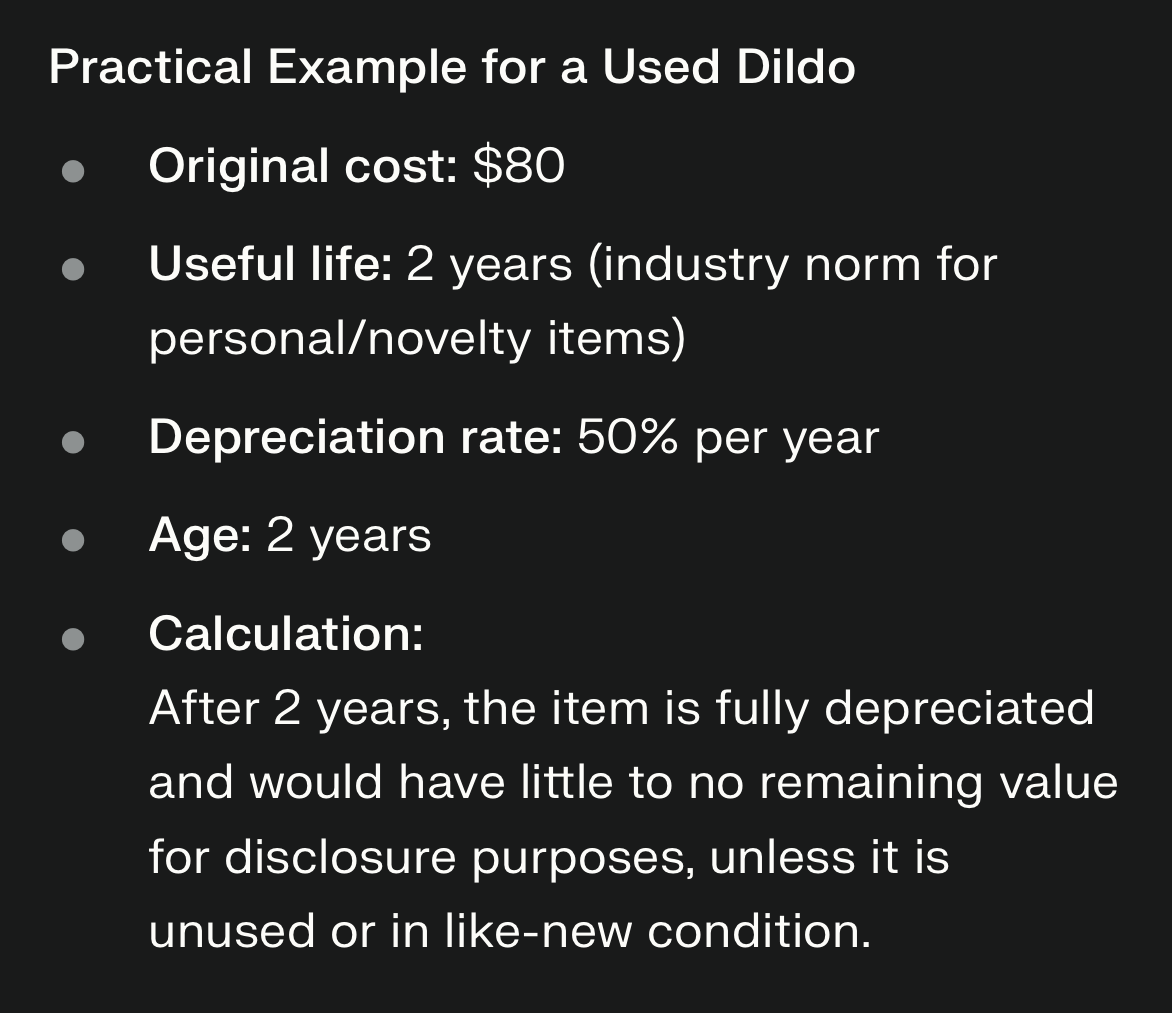
(pictured is the purchase of a different dildo—something she forgot to itemize) She’d logged it as joint property in her spreadsheet, which it was. She’d listed its original purchase value at $100, which was accurate as far as I could remember. She hadn’t included the date of purchase, but it was August of 2022. My eyes tracked across the row, at this point just for entertainment value, and there it was… she claimed that our two-and-a-half-year-old, well-used silicon friend was valued at… $75. I nearly did a spit take—even 📝Elizabeth Holmes would balk at that claim. Purely out of curiosity and still laughing, I asked 📝Perplexity, “What is the proper depreciation schedule for a used dildo?” It answered, with four cited sources, that according to industry depreciation schedules, toys—including adult toys—are typically assigned a useful life of 2 years. This equates to a depreciation rate of 50% per year. So our dildo, would—by categorical depreciation alone—now be valued at approximately $25. I’m not aware of thriving secondhand market for OUR dildo. Yet, when I told this to my friend 📝KittenwithFangs, she quickly informed me that hers appreciated in value and sold for more than their retail price—proof that, like art, value is primarily about 📝provenance and finding the right buyer.
But the laughter faded fast—reality came back to gag me with a calculator and spank me with a clipboard. Quickly, 📝I Realized I’d be expected to respond to her disclosure with my own assessment of fair market value—of not just our pink phallus, but everything else we owned. And if we were going to debate the semantics of something as insignificant as a dildo, we were in for a long, litigious crawl through the debris of us. Even without a fight, the process was going to be beastly. I told myself that at least, by being excessively thorough, I was preemptively making my future lawyers’ lives easier—and maybe, if it came to it, giving a judge their weirdest docket of the year.
Chaos Yields Clarity
A decade in startups had prepared me for this moment—not the dildo, but the chaos. My default response—honed through an 📝abundance of practice—was to take a deep breath and build my way out. I set out to engineer clarity from absurdity. I’ve always processed my emotions through cardio and creativity, so naturally, the 📝Bingeneering bender I’d been on for the last few months was bound to collide with divorce logistics. I didn’t expect it to culminate in the 📝automation of assessments of emotionally charged sex toys, but it’s easy to 📝Connect the Dots looking backward. I’m not sure dildo depreciation was the future 📝Steve Jobs imagined when he said “you have to 📝trust that the dots will somehow connect in your future”… but here we are—and here we go. Step one was inventory. To do this, I walked around my house with my phone, narrating every item to 📝Gemini Live—a newer feature from 📝Gemini that streams your camera to the AI. After about an hour, it generated a neatly itemized spreadsheet of everything it saw—without raising eyebrows that it didn’t have. I was now prepped for the paperwork gauntlet ahead. Next came purchase dates and prices. I’m a sucker for convenience, and many of the items had been ordered through 📝Amazon. But a few years ago, they’d killed the data export feature, so I’d started using 📝Amazon Order History Reporter—a plugin that let me extract all twelve years of my shopping history—an existential inventory unto itself. With a mostly complete inventory of the property and a fair chunk of the related purchase data, I imported everything into 📝Clay—a platform my ex once referred to as “my mistress.” Clay didn’t ask for attention—but it certainly rewarded it. 📝By and Large, Clay turns data into action with flexible, iterable workflows. It markets itself as a 📝Go-to-Market (GTM) Engineering platform, but it became something else entirely for me: a partner in processing chaos into a clear signal. I’d used it to find 📝Our Home, my therapist, and—more recently—a great litigation attorney. I’d been using it for nearly four years after discovering it on 📝Product Hunt in January 2021. I eventually became one of Clay’s first Certified Experts, and since then, it’s grown to have a $3.1B valuation. Over the years, the founders have come to know me as someone who doesn’t always use it conventionally—but always meaningfully. Clay matched the inventory from Gemini inventory with the relevant Amazon purchases and their metadata. For the non-Amazon items, I forwarded email receipts into 📝Make, a 📝No-Code📝automation platform, which parsed them into structured data and fed them neatly into my Clay table. All that was left was to use the data to assess the fair market values of each item. This was trickier. I didn’t just need an answer; I needed something defensible. At this point in my build, I was laughing maniacally at the idea of explaining this in court and justifying my assessments. For this, I needed three things:
- I needed an appropriate assessment of fair market value, obviously.
- I needed a consistent, fair market value assessment every time I ran and re-ran the same evaluation.
- I needed to assess both of the above using the same 📝Prompt Engineering, whether it was assessing a commonplace item, like an Apple HomePod, or one with less comparable data available, like a decrepit dilldo sold to market that only pays attention when the seller has a scene name and a subscription link. I used my 📝Prime Prompter (agent)—a 📝Custom GPT I’d made to help me create effective 📝Large Language Model (LLM) instructions—to create my prompts and added them into Clay. After minor refinement, it was laughably effective.
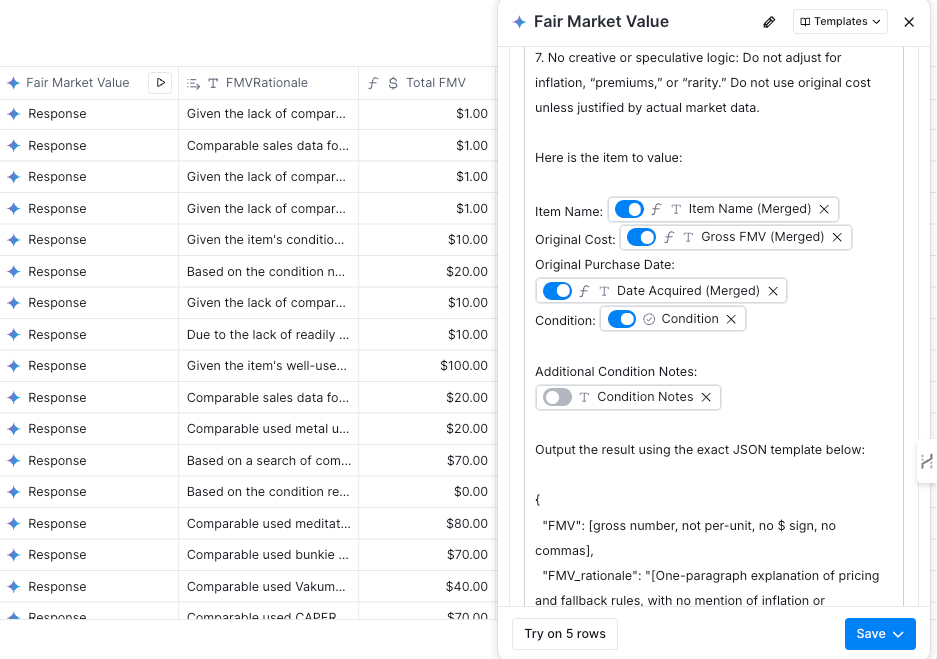
(Fellow nerd? Check out my 📝Dildo Depreciation: Technical Overview)
Silicone Sets Standard
The real test for my system wasn’t just about generating values—it was about generating trustworthy results. I needed fair market values that could be substantiated with market data and, if necessary, defended in a legal context. Fittingly, the dildo became my benchmark. After several rounds of prompt tuning and logic-gate wrestling, the system seemed to be work reliably. According to Gemini, the fair market value of our two-and-a-half-year-old, well-loved dildo was $0. Legally, it was worthless or close to it. Spiritually? Priceless. Releasing it to her ownership while I kept this story—absurd, irreverent, and oddly redemptive—felt like the perfect way to 📝Reclaim Agency. The comedy of the concept of dildo depreciation had pierced the bureaucratic fog of divorce, transforming the artifacts of a potent relationship into sources of self-possession and narrative power.
Humor Heals Heartbreak
What started as a soul-crushing slog through the machinery of divorce became the most ineffable comedic relief. Through the labor of automation and the unexpected delight of turning 📝Pain Into Product, laughter bloomed on the other side. All in all, the build took me about five hours and saved me countless hours in preparing my disclosures. Many advisors and investors of 📝One Inc have insisted that this should be turned into a product and sold to insurance companies. However, that’s a 📝One Studio project for another day. Follow along here: 📝Appraiser AI. Sharing this story with friends and strangers at gatherings and mixers, I watched people of all backgrounds collapse into raucous laughter at the idea of dildo depreciation, and then blink in awe at the automation behind it. The seemingly universal resonance reminded me of my 📝Facebook Ads Prank from 2014—a story that became a viral sensation and 📝catalyst for my career. I have no idea what will come from publishing this one, but writing it has been healing and joyful. Even now, randomly remembering the phrase “dildo depreciation” still makes me laugh out loud. And I’ll have at least one reminder a year when DildoDepreciation.com renews—an individual asset that I’ll keep in the divorce. While I wish things had ended differently between us, I’m deeply grateful for what we shared—and for who I’ve become, and am becoming, as a result. The process I went through after she left anchored a kind of sovereignty that I couldn’t have imagined, and the manifestation of this absurdity at the end was the most perfect of a bookmark to a chapter I’d hoped to never write. I learned that the people you meet at the wrong time simply aren’t the right people. 📝I Realized that the greatest act of love is letting go—and remaining resolute in that decision when being convinced otherwise. Now she has the space she said she needed to find her 📝self, and to make choices that she could differentiate from the echoes of my encouragement. I don’t know if there will ever be a second season of the 📝Future Wife Podcast, but since the separation, I’ve already recorded episodes for the 📝Pandimensional Partners Podcast—and I’m excited about who and what will unfold.
Afterthoughts and Artifacts
- While writing this piece, a cutie at the bar asked to read an early version, and I let her. A few days later, she offered to purchase me an appreciating dildo. This led me to wonder how much 📝providence could be bestowed onto a magical member and, thus, I bought appreciatingdildo.com as a placeholder for a possible continuation of this story.
- After publishing this, multiple friends—new and old—have purchased me dildos in solidarity, so much so that I’m going to need to build a whole display case (if you would like to add your contribution… See: 📝My Mailing Address).
- While at the first annual 📝Sculpt (Clay) conference, I had the opportunity to tell 📝Clay co-founders 📝Kareem Amin and 📝Varun Anand this story in person. I expected them to laugh at the absurdity, and they did. What I didn’t expect was that Varun would then RUN across the room and drag the videographer over by his arm and excitedly demand “TELL IT AGAIN! TELL IT AGAIN!” I’d wondered if/where that video would surface and a month later it appeared on Varun’s LinkedIn.
Contexts
- This is the 📝Root Memo for #️#dildo-depreciation.